ApoB Blood Test: What It Measures and When It Adds Useful Risk Information
Understand what ApoB measures, why it can reveal risk that LDL cholesterol underestimates, and when this test adds the most useful information.
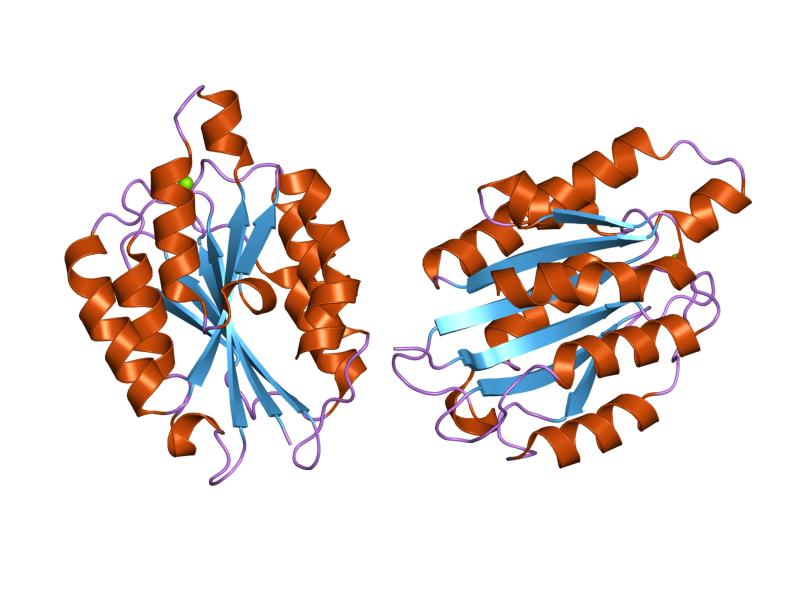
Image: Jawahar Swaminathan and MSD staff at the European Bioinformatics Institute / Wikimedia Commons / Public domain
ApoB measures the number of atherogenic particles in your blood, because each LDL, VLDL, and remnant particle carries exactly one ApoB molecule on its surface. This makes ApoB a direct count of potentially artery-damaging particles, distinct from LDL-C, which measures the total cholesterol content within those particles. The two usually agree, but they can become discordant — particularly in people with diabetes, metabolic syndrome, or elevated triglycerides — where someone can have a "normal" LDL-C but an elevated ApoB, indicating more particles than the cholesterol number alone suggested. ApoB is not yet part of routine standard screening for everyone, and guidelines have not fully converged on when it should replace or simply supplement LDL-C.
Imagine LDL-C and ApoB as two different ways of describing a fleet of delivery trucks. LDL-C tells you the total weight of cargo across all trucks. ApoB tells you how many trucks there are. Usually more cargo means more trucks — but sometimes you can have the same total cargo weight spread across more, smaller trucks. In cardiovascular risk, more trucks (particles) generally means more opportunities to deposit material in artery walls, even if the total cargo (cholesterol) looks the same.
- ApoB counts atherogenic particles directly; LDL-C measures cholesterol content within those particles.
- The two usually agree, but discordance is more common with diabetes, metabolic syndrome, obesity, or high triglycerides.
- ApoB can reveal elevated particle number even when LDL-C looks normal.
- ApoB is not yet a routine universal screening test, and guidelines haven’t fully converged on standalone treatment targets.
What the test measures
Each LDL, VLDL, IDL, and remnant lipoprotein particle carries a single ApoB-100 molecule on its surface, while HDL particles carry a different protein (ApoA-I) instead. Measuring ApoB gives a direct count of the total number of these potentially atherogenic particles — information that neither LDL-C nor non-HDL cholesterol directly provides, since both of those measure cholesterol content rather than particle number.
How the main pattern is interpreted
When ApoB and LDL-C agree — both proportionally high, proportionally normal, or proportionally low — there’s usually little additional information gained from ApoB. When they disagree, it usually means particle size distribution is unusual: someone with many small, cholesterol-poor LDL particles can have a normal LDL-C but an elevated ApoB, because there are simply more particles even though each carries less cholesterol. This pattern is more common in insulin resistance, type 2 diabetes, and metabolic syndrome — situations flagged in the ESC/EAS 2019 guideline as scenarios where ApoB measurement is particularly informative.
Reference ranges versus cardiovascular-risk thresholds
Clinical policy and payer guidance commonly reference an ApoB of 130 mg/dL or higher as corresponding roughly to an LDL-C of 160 mg/dL or higher, used as one indication for measuring ApoB rather than a fixed treatment target. Unlike LDL-C, which now has well-established, risk-category-specific goals across major guidelines, ApoB treatment targets are less uniformly agreed upon, and this article won’t present a single universal ApoB number as the "right" target for every reader.
What can distort the result
ApoB, like LDL-C, can be affected by recent illness, significant dietary shifts, and certain medicines. Because ApoB doesn’t rely on the triglyceride-dependent Friedewald calculation, it isn’t distorted by high triglycerides the way calculated LDL-C is — which is part of why it holds up well precisely in the situations where LDL-C becomes less reliable.
What the result does not prove
ApoB does not diagnose cardiovascular disease and does not, by itself, tell you which specific particle type (LDL versus VLDL versus remnants) is responsible for an elevated count. It also doesn’t replace the broader risk assessment that includes blood pressure, smoking, diabetes, and family history.
Common misunderstandings
A common misunderstanding is assuming ApoB should replace LDL-C for everyone. Current guidance treats ApoB as most useful in specific situations — elevated triglycerides, diabetes, obesity, metabolic syndrome, or known LDL-ApoB discordance — rather than as a universal upgrade needed by every person getting a lipid panel.
Practical next-step guidance
If you have diabetes, elevated triglycerides, metabolic syndrome, or a lipid panel that seems inconsistent with your overall risk profile, asking about ApoB testing is reasonable and may add useful information. If your LDL-C and non-HDL cholesterol are already consistent with your risk profile and you don’t have these risk-enhancing conditions, ApoB testing is less likely to change the picture meaningfully.
- An elevated ApoB, particularly discordant with a seemingly normal LDL-C, is a reasonable prompt for a broader risk conversation with a clinician rather than a number to interpret alone.
- ApoB–LDL discordance is most relevant in diabetes, metabolic syndrome, obesity, and elevated triglycerides — situations where this test is most likely to add useful information.
- This article does not recommend a specific ApoB target or medication for any individual reader.
Limitations and uncertainty
ApoB is not yet available through all routine labs, and guideline bodies have not fully converged on standalone ApoB treatment targets the way they have for LDL-C — this remains an evolving area of lipid management.
Frequently asked questions
Related articles
 Laboratory Tests
TSH Test: Normal Range, High, Low & What Your Result Actually Means
TSH is the single most important thyroid number. Understand normal ranges by age and pregnancy, what a high or low value really tells you, and the two follow-up tests that clinch the diagnosis.
 Laboratory Tests
HbA1c Test: Normal Range, Prediabetic, Diabetic Cut-offs & How to Lower It
HbA1c reflects your average blood sugar over ~3 months. Understand every threshold — normal, prediabetes, diabetes — and the realistic actions that move the number.
 Laboratory Tests
LDL Cholesterol: Optimal Numbers, High Numbers, and How to Read Yours
LDL is the "bad" cholesterol only if you leave the story there. Understand optimal targets by risk group, the ApoB perspective, and the interventions that actually shift the number.