Coronary CT Angiography (CCTA) Explained: Ruling Out Coronary Disease in Chest Pain
CCTA is now first-line for stable chest pain workup in the UK. Learn CAD-RADS, calcium scoring, and how it changed cardiac testing.
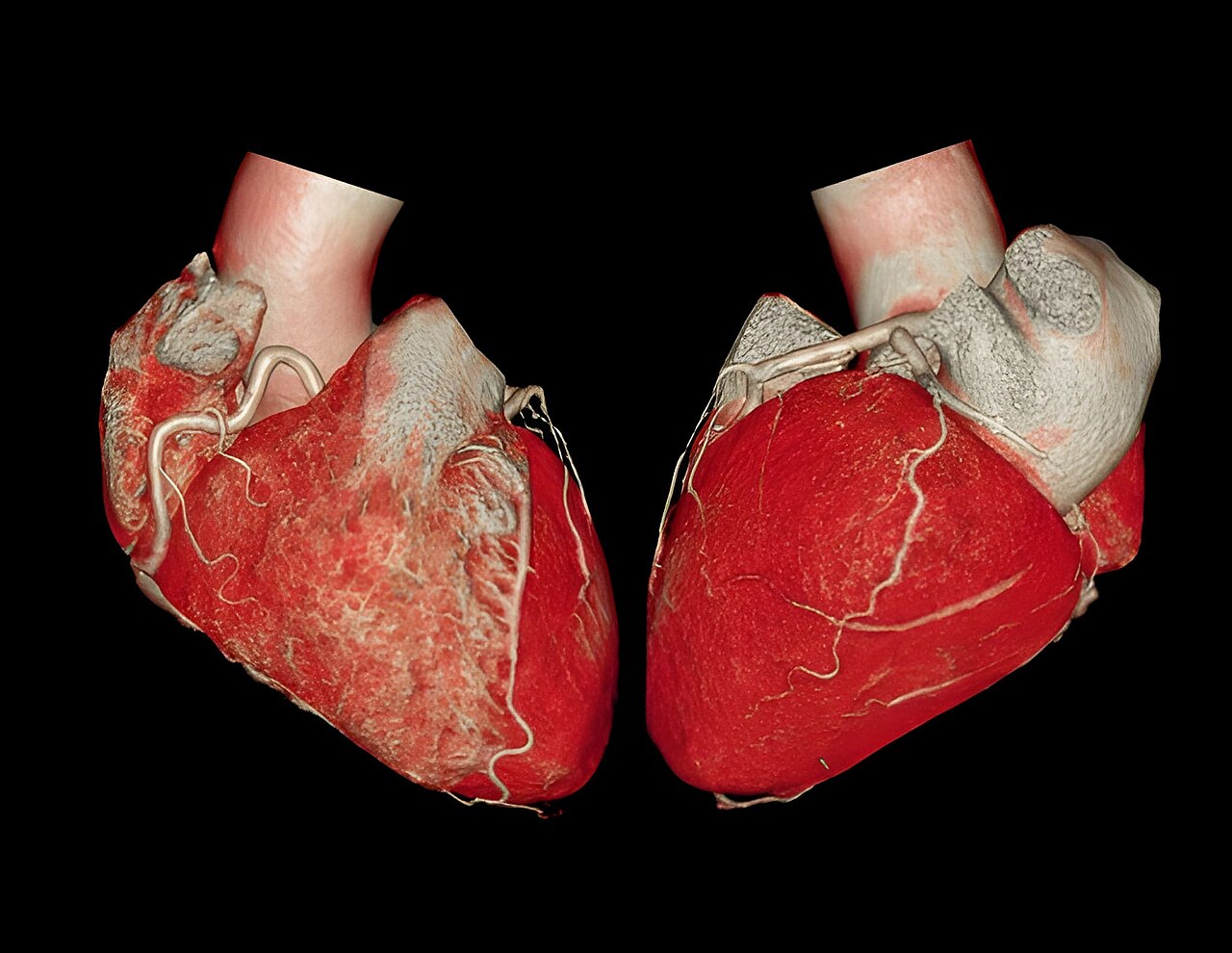
CCTA is the first-line test for stable chest pain of suspected coronary origin under NICE CG95 (updated 2016). It has near 100% negative predictive value — a normal CCTA reliably excludes obstructive coronary disease. Radiation dose is ~3–5 mSv with modern scanners. CAD-RADS grades severity from 0 (no disease) to 5 (occlusion).
CCTA has transformed the workup of stable chest pain. NICE CG95 (2016 update) recommends CCTA as the FIRST-LINE test in patients with typical or atypical anginal chest pain and no known CAD — replacing exercise ECG and simplifying pathways. The 2018 SCOT-HEART trial showed a 41% lower rate of coronary death or non-fatal MI at 5 years in CCTA-guided vs standard care groups. CAD-RADS 2.0 (2022) categorises: 0 (no plaque), 1 (< 25% stenosis), 2 (25–49%), 3 (50–69%), 4 (70–99%), 5 (occlusion), each with prescribed management. Coronary artery calcium (CAC) score (Agatston) is a related non-contrast test predicting cardiovascular risk in asymptomatic patients — CAC of 0 in intermediate-risk primary-prevention patients often justifies deferring statins. Radiation dose is ~3–5 mSv on modern low-dose protocols. Optimal image quality requires heart rate < 65 bpm (beta-blockers pre-scan), sinus rhythm ideally, and breath-hold cooperation. FFR-CT (fractional flow reserve derived from CCTA) adds functional data non-invasively in ambiguous 40–70% stenoses.
- NICE first-line
- Stable chest pain workup (CG95)
- Negative predictive value
- ~99%
- Dose
- ~3–5 mSv
- Reporting
- CAD-RADS 2.0
- Prep
- Beta-blocker to HR < 65, GTN before scan
CAD-RADS 2.0 categories
| Category | Stenosis | Action |
|---|---|---|
| 0 | No plaque | Reassure, prevention |
| 1 | < 25% | Prevention + optimise risk factors |
| 2 | 25–49% | Prevention intensification |
| 3 | 50–69% | Consider functional testing or FFR-CT |
| 4 | 70–99% | Invasive angiography likely |
| 5 | 100% | Invasive angiography |
Calcium scoring — separate concept
Non-contrast, low-dose (~1 mSv) scan measuring calcified plaque burden.
Agatston score 0 = very low 10-year event risk; can defer statin in intermediate-risk primary prevention.
Score > 100 = higher risk; strengthens indication for statin and BP control.
Score does not measure soft (vulnerable) plaque — a normal CCTA is still preferable in symptomatic patients.
- CAD-RADS 4/5 — cardiology referral for invasive angiography.
- Acute chest pain — do NOT wait for CCTA; use ACS pathway.
- Left main / three-vessel disease — surgical revascularisation discussion.
Stable chest pain workup
- 1Typical/atypical anginal chest pain?CCTA first-line.
- 2CCTA 50–69%?Functional test or FFR-CT.
- 3CCTA ≥ 70%?Invasive angiography.
- 4Asymptomatic intermediate risk?Consider CAC score.
Related questions people ask
Frequently asked questions
- CCTA is first-line for stable chest pain in the UK.
- Very high negative predictive value.
- CAD-RADS categorises severity and drives action.
- CAC scoring refines primary-prevention decisions.
- Beta-blocker + GTN prep improves image quality.
References
2 sources- NICE CG95Chest pain of recent onset: assessment and diagnosis
UK national guideline.
nice.org.uk
- SCCTCAD-RADS 2.0
Society of Cardiovascular Computed Tomography.
scct.org
Related articles
 Imaging & Diagnostic Tests
Chest X-ray Explained: What It Shows, When You Need One, and Radiation Dose
A chest X-ray delivers a chest radiation dose equivalent to a few days of background radiation. Learn what it detects and what it misses.
 Imaging & Diagnostic Tests
CT Head Scan Explained: When It Is Needed for Stroke, Trauma and Headache
A non-contrast CT head is the first imaging test in stroke and head trauma. Learn NICE criteria, radiation dose, and what CT misses.
 Imaging & Diagnostic Tests
CTPA (CT Pulmonary Angiogram) Explained: Diagnosing Pulmonary Embolism
CTPA is the reference standard for pulmonary embolism. Learn indications, radiation dose, contrast risks, and pregnancy alternatives.