HDL Cholesterol: Why "Good Cholesterol" Is More Complicated Than It Sounds
Understand why HDL cholesterol is linked to lower cardiovascular risk at a population level, why raising it hasn’t reliably improved outcomes, and why very high HDL isn’t automatically better.
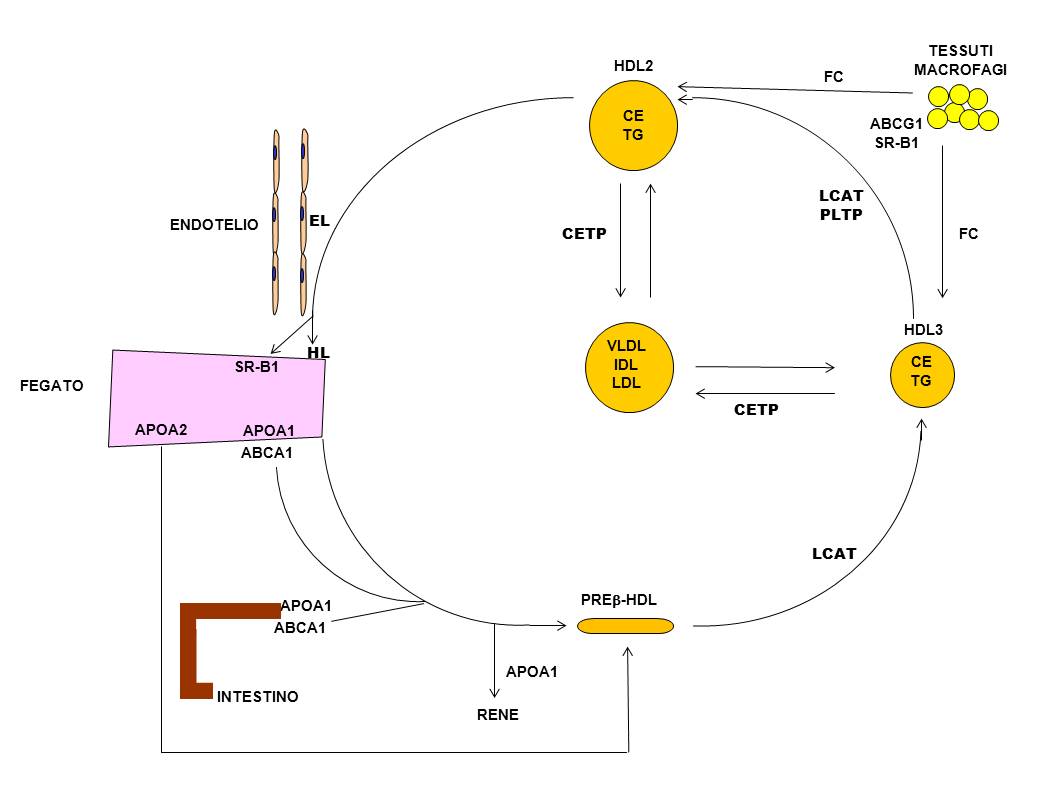
Image: ALEISF / Wikimedia Commons / CC BY-SA 4.0
HDL cholesterol is associated with lower cardiovascular risk across large populations, historically earning it the label "good cholesterol." But this association doesn’t mean raising HDL with medication or supplements reliably lowers risk — several drug trials designed specifically to raise HDL failed to reduce cardiovascular events. Very high HDL is not consistently more protective than moderately high HDL, and some research has raised questions about unusually elevated levels. Most importantly, a favorable HDL result does not offset or cancel the risk associated with high LDL, high ApoB, or smoking. HDL concentration is also different from HDL function, and the standard blood test measures concentration only.
"Good cholesterol" is a useful shorthand, but it oversells what the number can tell you. HDL’s association with lower risk comes from decades of population studies, not from proof that boosting HDL itself changes outcomes. Treat your HDL number as one data point in a larger pattern — not a shield against the rest of your lipid panel.
- HDL is associated with lower cardiovascular risk at a population level, but this is a correlation, not proof that raising HDL directly lowers individual risk.
- Drug trials designed to raise HDL pharmacologically have generally not reduced cardiovascular events.
- Very high HDL has not been shown to be more protective than a moderately favorable level, and some evidence raises questions about extreme elevations.
- HDL cannot cancel out the risk associated with high LDL, high ApoB, or smoking.
What the test measures
HDL particles are involved in transporting cholesterol away from tissues, including artery walls, and back toward the liver for processing — a process sometimes called reverse cholesterol transport. The standard blood test measures the total cholesterol carried within this HDL particle population. It does not measure how efficiently those particles are performing this transport function, how many HDL particles you have, or their size distribution — all of which are areas of active research distinct from the basic concentration number.
How the main pattern is interpreted
HDL is generally read as one part of the broader lipid pattern rather than as an independent, stand-alone signal. A low HDL alongside high triglycerides and high LDL — sometimes reflecting underlying insulin resistance — is interpreted as part of a more concerning overall pattern. A low HDL with an otherwise favorable panel and no other risk factors carries different weight. Similarly, a high HDL in someone who also smokes or has a high LDL doesn’t meaningfully reduce the risk associated with those other factors.
Reference ranges versus cardiovascular-risk thresholds
Labs typically flag HDL below roughly 40 mg/dL in men and 50 mg/dL in women as a marker worth noting, values referenced in both the AHA/ACC and ESC/EAS frameworks as part of overall risk assessment — but there isn’t a treatment target for HDL the way there is for LDL. Guidelines don’t set a goal to "raise HDL to X," because there’s no strong trial evidence that doing so pharmacologically improves outcomes. This is a meaningful and often overlooked distinction: LDL has treatment targets; HDL, in current guidelines, functions mainly as a risk-assessment input, not a treatment target.
What can distort the result
Smoking lowers HDL. Regular aerobic exercise and moderate alcohol intake are associated with higher HDL in observational data, though this doesn’t establish that the exercise or alcohol itself is responsible for any risk reduction attributed to higher HDL. Certain medicines (including some beta-blockers and anabolic steroids) can lower HDL; other medicines can raise it without necessarily lowering cardiovascular risk. Rapid weight change and acute illness can also shift HDL temporarily.
What the result does not prove
An HDL result does not prove that your cardiovascular risk is low if other risk factors (high LDL, smoking, diabetes, high blood pressure) are present. It also does not prove that any lifestyle change you’ve made to raise it has translated into lower cardiovascular risk — the HDL number itself is not a reliable proxy for that outcome.
Common misunderstandings
The most common misunderstanding is treating high HDL as a counterbalance to other unfavorable results — "my LDL is high, but so is my HDL, so it evens out." Current evidence doesn’t support that kind of arithmetic. A second misunderstanding is assuming any HDL-raising intervention (supplement, medication, extreme diet) is automatically beneficial; several were tested specifically for this purpose and did not reduce cardiovascular events despite successfully raising HDL numbers.
Practical next-step guidance
If your HDL is low, the more useful next step is usually looking at your overall pattern — LDL, triglycerides, blood pressure, smoking status — rather than searching for an HDL-specific fix. If your HDL is unusually high (well above typical population levels) with no clear explanation, mentioning this to a clinician is reasonable, since very high levels are sometimes linked to rare genetic conditions that warrant a broader look rather than celebration.
- A very low HDL combined with high triglycerides and elevated LDL is generally treated as part of a higher-risk pattern warranting broader risk assessment, not addressed by targeting HDL alone.
- Unusually high or unusually low HDL without an obvious explanation is worth mentioning to a clinician as part of your overall risk picture.
- This article does not recommend a supplement, medication, or specific lifestyle program to raise HDL.
Limitations and uncertainty
The standard HDL test cannot distinguish HDL that is functioning well from HDL that isn’t, and population-level associations between HDL and risk don’t establish that changing your HDL number changes your personal risk.
Frequently asked questions
Related articles
 Laboratory Tests
TSH Test: Normal Range, High, Low & What Your Result Actually Means
TSH is the single most important thyroid number. Understand normal ranges by age and pregnancy, what a high or low value really tells you, and the two follow-up tests that clinch the diagnosis.
 Laboratory Tests
HbA1c Test: Normal Range, Prediabetic, Diabetic Cut-offs & How to Lower It
HbA1c reflects your average blood sugar over ~3 months. Understand every threshold — normal, prediabetes, diabetes — and the realistic actions that move the number.
 Laboratory Tests
LDL Cholesterol: Optimal Numbers, High Numbers, and How to Read Yours
LDL is the "bad" cholesterol only if you leave the story there. Understand optimal targets by risk group, the ApoB perspective, and the interventions that actually shift the number.