LDL Cholesterol: What Normal, Borderline and High Levels Mean
Learn what LDL cholesterol measures, why the same LDL number can lead to different decisions in different people, and why no single LDL target applies to everyone.
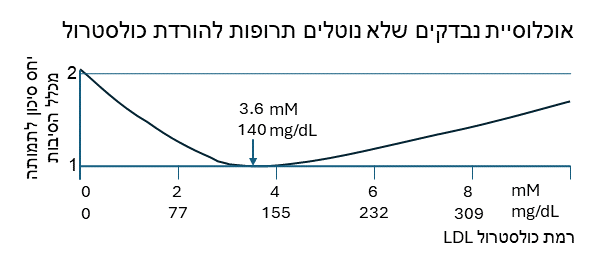
Image: Nirts / Wikimedia Commons / CC0
LDL cholesterol measures the cholesterol carried by particles capable of depositing in artery walls over time. It does not, by itself, define your cardiovascular risk or diagnose disease — the same LDL number carries different weight depending on your age, blood pressure, diabetes status, kidney health, smoking history, and whether you already have cardiovascular disease. Current guidelines use LDL alongside overall risk category to set individualized treatment targets, which differ between primary prevention (no prior event) and secondary prevention (established disease). An LDL of 190 mg/dL or higher without an obvious cause can raise the possibility of an inherited pattern, which requires further evaluation rather than assumption from one result.
LDL gets treated in casual conversation like a single verdict — high is bad, low is good, done. The guidelines that actually govern clinical decisions don’t work that way. They ask "how high, and in whom?" A moderately elevated LDL in an otherwise low-risk 30-year-old is a different conversation than the same number in a 60-year-old with diabetes and a family history of early heart attacks. Age, other risk factors, and prior cardiovascular history change what the same LDL number means.
- LDL-C measures cholesterol content within LDL particles, not the number of particles itself.
- Risk from a given LDL level depends heavily on age, blood pressure, diabetes, smoking, kidney disease, and existing cardiovascular disease.
- Treatment targets differ between primary prevention and secondary prevention, and across risk categories within each.
- LDL-C of 190 mg/dL or higher without an obvious secondary cause raises the possibility of an inherited very-high-LDL pattern, which needs further evaluation rather than a diagnosis from one test.
What the test measures
LDL particles transport cholesterol from the liver to tissues throughout the body. When there’s more LDL cholesterol circulating than tissues need, these particles can infiltrate artery walls, where they contribute to the fatty deposits that characterize atherosclerosis. LDL-C, the number on your report, reflects the total cholesterol carried within this particle population — not how many individual particles are doing the carrying, which is closer to what ApoB measures (covered in its own Elements84 guide).
How the main pattern is interpreted
Clinical guidelines don’t interpret LDL in isolation — they interpret it against a calculated cardiovascular risk estimate. The 2018 AHA/ACC guideline groups people broadly into: those with LDL-C ≥190 mg/dL (treated as high lifetime risk regardless of a calculated score), adults with diabetes, and everyone else, for whom a 10-year risk estimate combined with LDL level and risk-enhancing factors guides the conversation about statin therapy. The ESC/EAS 2019 guideline (unchanged in its 2025 focused update) uses risk categories — low, moderate, high, and very high — each with its own LDL-C goal, informed by SCORE2 risk estimation alongside conditions like diabetes duration, chronic kidney disease, and existing atherosclerotic disease.
Reference ranges versus cardiovascular-risk thresholds
It’s worth being precise about the difference between a lab reference range and a treatment threshold, because they’re often conflated. A lab might print "under 100 mg/dL" as a general reference, but that’s not the same as a guideline-defined treatment goal. Under the ESC/EAS framework, LDL-C goals scale with risk category: very-high-risk primary prevention patients with familial hypercholesterolaemia are guided toward a goal below 55 mg/dL, high-risk patients toward below 70 mg/dL, moderate-risk patients toward below 100 mg/dL, and low-risk patients toward below 116 mg/dL. Under the AHA/ACC framework, an LDL-C of 70 mg/dL or higher in someone with established atherosclerotic cardiovascular disease at very high risk is the threshold used to consider adding therapy beyond a statin. These are risk-category-specific clinical targets set collaboratively between patient and clinician — not universal numbers this article is recommending for any individual reader.
What can distort the result
The Friedewald calculation used for most reported LDL-C becomes progressively less reliable as triglycerides rise, sometimes underestimating true LDL-C. Recent illness, extreme short-term dietary changes, and certain medicines (including some steroids and immunosuppressants) can shift LDL temporarily. A single elevated reading, especially if it’s your first-ever lipid panel, is often worth confirming with a repeat test before drawing conclusions.
What the result does not prove
An LDL result does not diagnose atherosclerosis, does not confirm familial hypercholesterolaemia by itself, and does not predict a specific timeline for a cardiovascular event. Confirming an inherited very-high-LDL condition typically involves clinical criteria (such as the Dutch Lipid Clinic Network score), family history, physical findings in some cases, and sometimes genetic testing — not a single LDL value.
Common misunderstandings
A common misunderstanding is assuming there’s one "ideal" LDL number that should apply to everyone, when guidelines explicitly set different targets by risk category. Another is treating any elevated LDL as evidence of an inherited disorder — most elevated LDL reflects a combination of diet, lifestyle, age-related change, and genetics that isn’t a distinct, rare inherited condition.
Practical next-step guidance
If your LDL is elevated, the most useful next conversation is usually about your overall cardiovascular risk category — not the LDL number alone. If LDL-C is 190 mg/dL or higher without an obvious explanation (like an unusually high-fat short-term diet), asking about further evaluation for an inherited pattern, including family history review, is reasonable. If your triglycerides are also elevated, ApoB or non-HDL cholesterol may give a clearer picture than LDL-C alone, both covered in their own Elements84 guides.
- An LDL-C at or above 190 mg/dL without an obvious secondary cause is treated in major guidelines as warranting closer evaluation regardless of your calculated risk score.
- In people with existing atherosclerotic cardiovascular disease, persistently elevated LDL despite treatment is generally a prompt for a more detailed clinical review rather than a wait-and-see approach.
- This article does not recommend a statin, other medication, or a specific LDL target for any individual reader.
Limitations and uncertainty
LDL-C measures cholesterol content, not particle count, and can understate risk in people with high triglycerides, diabetes, or metabolic syndrome — situations where ApoB may add useful information, discussed in the Elements84 ApoB guide.
Frequently asked questions
Related articles
 Laboratory Tests
TSH Test: Normal Range, High, Low & What Your Result Actually Means
TSH is the single most important thyroid number. Understand normal ranges by age and pregnancy, what a high or low value really tells you, and the two follow-up tests that clinch the diagnosis.
 Laboratory Tests
HbA1c Test: Normal Range, Prediabetic, Diabetic Cut-offs & How to Lower It
HbA1c reflects your average blood sugar over ~3 months. Understand every threshold — normal, prediabetes, diabetes — and the realistic actions that move the number.
 Laboratory Tests
LDL Cholesterol: Optimal Numbers, High Numbers, and How to Read Yours
LDL is the "bad" cholesterol only if you leave the story there. Understand optimal targets by risk group, the ApoB perspective, and the interventions that actually shift the number.