Lipoprotein(a) Test: Inherited Heart Risk That a Standard Cholesterol Test Can Miss
Learn why Lipoprotein(a) is largely inherited, why a standard lipid panel doesn’t measure it, and what a high result can and cannot tell you about future cardiovascular risk.
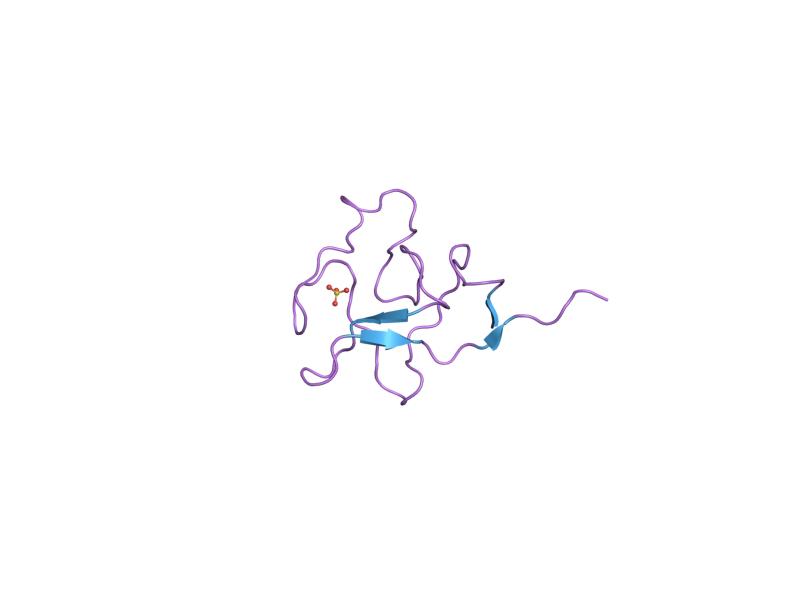
Image: Jawahar Swaminathan and MSD staff at the European Bioinformatics Institute / Wikimedia Commons / Public domain
Lipoprotein(a), or Lp(a), is a cholesterol-carrying particle whose blood concentration is determined mostly by genetics — over 90% inherited — and changes very little in response to diet or exercise. A standard lipid panel does not measure it, which means someone with an entirely unremarkable LDL and HDL can still carry significantly elevated cardiovascular and aortic-valve risk from Lp(a) alone. Major guidelines now recommend measuring it at least once in adulthood. Results can be reported in mg/dL or nmol/L, and because the particle’s protein component varies in size between individuals, converting between these units using a single fixed formula is unreliable. A high result identifies increased lifetime risk — it does not predict that a cardiovascular event will definitely occur.
Lp(a) is the cluster’s clearest example of risk that isn’t primarily lifestyle-driven. Most people never get tested for it because it isn’t part of routine panels, and most people who are tested get it checked exactly once in their life — which is actually appropriate, given how genetically fixed the level tends to be.
- Lp(a) concentration is over 90% genetically determined and generally stable across adulthood.
- Standard lipid panels don’t include it — it must be specifically requested.
- Major guidelines recommend testing at least once in adulthood, particularly with a family history of early heart disease.
- mg/dL and nmol/L results cannot be reliably converted into each other using one universal formula.
What the test measures
Lp(a) is an LDL-like particle with an additional protein, apolipoprotein(a), attached. This extra protein varies substantially in size between individuals due to genetic variation, which affects both how the particle behaves and how reliably it can be measured and compared across different assay methods. Lp(a) is thought to contribute to cardiovascular risk through mechanisms distinct from LDL alone, including a role in promoting calcification of the aortic valve.
How the main pattern is interpreted
Because Lp(a) is inherited, the most useful interpretive context is often family history. A high Lp(a) in someone with a family history of early heart attacks or unexplained aortic valve disease reinforces the likely genetic contribution to that family pattern. Lp(a) is generally interpreted as a risk-enhancing factor added on top of your overall cardiovascular risk assessment — not as a stand-alone diagnosis, and not as a factor that overrides everything else in your profile.
Reference ranges versus cardiovascular-risk thresholds
Multiple related but not identical threshold frameworks exist, and it’s worth being explicit about that rather than flattening them into one number. The 2019 ESC/EAS guideline (unchanged in its 2025 focused update) identifies levels above 180 mg/dL (>430 nmol/L) as potentially carrying a lifetime cardiovascular risk comparable to heterozygous familial hypercholesterolaemia, and treats levels above roughly 50 mg/dL (105 nmol/L) as the point where risk becomes clinically relevant and can inform reclassification of a person’s overall risk category. Separately, the National Lipid Association’s 2024 focused update categorizes levels under 75 nmol/L (30 mg/dL) as low risk, 75–125 nmol/L (30–50 mg/dL) as intermediate risk, and 125 nmol/L (50 mg/dL) or above as high risk. These frameworks broadly agree on the general territory (around 50 mg/dL/100–125 nmol/L being a meaningful threshold) while using somewhat different exact cut-offs — a genuine area of ongoing refinement rather than settled universal agreement.
What can distort the result
Lp(a) levels are relatively stable compared to other lipid values, but some situations can shift them: kidney disease can raise Lp(a), while significant liver disease (since Lp(a) is produced in the liver) can lower it. Lp(a) rises modestly — roughly 15–20% — around and after menopause in women, though this typically doesn’t change risk category for women who already have low levels. Because Lp(a) is largely genetically fixed, diet and exercise typically produce only modest changes, unlike LDL or triglycerides.
What the result does not prove
A high Lp(a) does not prove that a cardiovascular event or aortic valve disease will occur — it identifies increased risk, which is a probability concept, not a certainty. It also doesn’t, by itself, diagnose any specific cardiovascular condition; it’s one input into a broader risk assessment.
Common misunderstandings
A common misunderstanding is assuming Lp(a) needs to be retested regularly like LDL or triglycerides. Because it’s largely genetically determined and relatively stable, most guidelines support a single lifetime measurement for most people, rather than routine repeat testing. Another misunderstanding is trying to directly convert an old mg/dL result to nmol/L (or vice versa) using a simple multiplication factor — this isn’t reliable because of variation in the protein component’s size between individuals and between assays.
Practical next-step guidance
If you have a family history of early heart disease or unexplained aortic valve disease, or if you haven’t had Lp(a) checked at any point in adulthood, asking your clinician about testing it once is a reasonable step. If your Lp(a) is already known and was low or normal at a prior test, repeating it isn’t usually necessary given how stable it tends to be. Since specific Lp(a)-lowering treatments remain limited, an elevated result is generally used to inform how aggressively other modifiable risk factors (like LDL and blood pressure) are managed, rather than treated in isolation.
- A Lp(a) above roughly 180 mg/dL (430 nmol/L) is treated by the ESC/EAS guideline as potentially carrying risk comparable to an inherited high-cholesterol condition and is a reasonable prompt for a more detailed cardiovascular risk conversation.
- A family history of early, unexplained cardiovascular disease alongside an elevated Lp(a) is also worth discussing further with a clinician.
- This article does not recommend a specific treatment for elevated Lp(a), since options remain limited and evolving.
Limitations and uncertainty
Different guideline bodies use somewhat different exact Lp(a) thresholds, and unit conversion between mg/dL and nmol/L remains unreliable across individuals — both genuine, unresolved limitations rather than errors in any one source.
Frequently asked questions
Related articles
 Laboratory Tests
TSH Test: Normal Range, High, Low & What Your Result Actually Means
TSH is the single most important thyroid number. Understand normal ranges by age and pregnancy, what a high or low value really tells you, and the two follow-up tests that clinch the diagnosis.
 Laboratory Tests
HbA1c Test: Normal Range, Prediabetic, Diabetic Cut-offs & How to Lower It
HbA1c reflects your average blood sugar over ~3 months. Understand every threshold — normal, prediabetes, diabetes — and the realistic actions that move the number.
 Laboratory Tests
LDL Cholesterol: Optimal Numbers, High Numbers, and How to Read Yours
LDL is the "bad" cholesterol only if you leave the story there. Understand optimal targets by risk group, the ApoB perspective, and the interventions that actually shift the number.