Non-HDL Cholesterol Explained: When It Adds More Than LDL Alone
Learn how non-HDL cholesterol is calculated, why it can be more informative than LDL when triglycerides are elevated, and how it relates to ApoB.
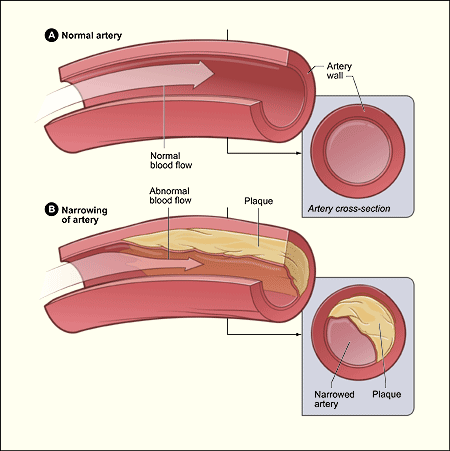
Image: NHLBI / Wikimedia Commons / Public domain
Non-HDL cholesterol is calculated by subtracting HDL cholesterol from total cholesterol, capturing the cholesterol carried by all potentially atherogenic particles — not just LDL, but also VLDL and other triglyceride-rich remnant particles. It becomes especially useful when triglycerides are elevated, a situation where standard calculated LDL-C becomes less reliable. Non-HDL doesn’t require fasting to the same degree LDL-C calculations traditionally have. It isn’t identical to ApoB — non-HDL still measures cholesterol content, not particle number — but it’s a more complete measure of atherogenic cholesterol burden than LDL-C alone, without being a universal replacement for LDL in every clinical situation.
Non-HDL cholesterol solves a specific problem: LDL-C calculations get shaky when triglycerides are high, right around the time you most need an accurate atherogenic-cholesterol number. Non-HDL sidesteps that problem because it’s derived from two directly reliable numbers — total cholesterol and HDL — rather than a triglyceride-dependent formula.
- Non-HDL = Total Cholesterol − HDL Cholesterol.
- It captures LDL plus VLDL and other triglyceride-rich remnant particles, giving a broader atherogenic-cholesterol picture than LDL-C alone.
- It’s especially useful when triglycerides are elevated, since that undermines standard LDL-C calculations.
- It’s related to, but not the same as, ApoB — non-HDL measures cholesterol content, not particle count.
What the test measures
Non-HDL cholesterol isn’t measured directly — it’s calculated from two values your lipid panel already reports. By subtracting HDL cholesterol (generally considered non-atherogenic) from total cholesterol, what remains is the cholesterol carried by every particle type associated with atherosclerotic risk: LDL, VLDL, IDL, and remnant particles left over after triglyceride-rich particles are partially metabolized.
How the main pattern is interpreted
Non-HDL is interpreted similarly to LDL — higher levels are associated with greater atherogenic burden — but it captures more of the picture in people with elevated triglycerides, because VLDL and remnant particles carry meaningful atherogenic cholesterol that LDL-C alone doesn’t count. In someone with normal triglycerides, non-HDL and LDL-C tend to track closely together and rarely disagree meaningfully. In someone with elevated triglycerides, non-HDL can reveal atherogenic cholesterol burden that a calculated LDL-C underestimates.
Reference ranges versus cardiovascular-risk thresholds
Both the AHA/ACC and ESC/EAS frameworks discuss non-HDL thresholds that roughly parallel LDL-C thresholds, generally set about 30 mg/dL higher (reflecting a typical HDL contribution). The AHA/ACC 2018 guideline references a non-HDL cholesterol of 220 mg/dL or higher in the context of severe hypercholesterolemia patterns warranting closer evaluation, paralleling the LDL-C ≥190 mg/dL threshold. As with LDL, these are risk-category-informed clinical reference points, not one-size-fits-all targets — the right threshold for you depends on your overall risk profile.
What can distort the result
Because non-HDL depends on total cholesterol and HDL, anything that distorts either of those — recent illness, significant short-term dietary change, certain medicines, pregnancy — will shift the non-HDL calculation too. Unlike LDL-C, non-HDL is not distorted by high triglycerides, since triglycerides aren’t part of its calculation. This is precisely why it holds up better than LDL-C when triglycerides are elevated.
What the result does not prove
Non-HDL, like LDL-C, does not diagnose cardiovascular disease or confirm a specific inherited lipid disorder. It also doesn’t reveal particle number — two people with identical non-HDL cholesterol can have meaningfully different numbers of atherogenic particles, which is where ApoB testing can add further information.
Common misunderstandings
A common misunderstanding is treating non-HDL as simply a "better" version of LDL that should replace it universally. Non-HDL adds the most value specifically when triglycerides are elevated; in people with normal triglycerides, LDL-C and non-HDL usually tell a similar story, and neither is inherently superior in that context.
Practical next-step guidance
If your triglycerides are elevated and your LDL-C looks reassuring, checking your non-HDL cholesterol (often already calculated on your existing panel) can reveal whether atherogenic cholesterol burden is actually higher than LDL-C alone suggests. If non-HDL and LDL-C tell a similar story, there’s usually no need to pursue further testing beyond your standard panel.
- A non-HDL cholesterol of 220 mg/dL or higher, particularly without an obvious secondary cause, is a reasonable prompt for further clinical evaluation, paralleling the AHA/ACC guideline’s treatment of severe LDL elevation.
- Elevated non-HDL alongside high triglycerides is generally treated as part of a broader risk pattern rather than assessed alone.
- This article does not recommend medication or a specific non-HDL target for any individual reader.
Limitations and uncertainty
Non-HDL is a calculated value inheriting variability from its two components, and while it captures more atherogenic particle types than LDL-C, it still measures cholesterol content rather than particle number the way ApoB does.
Frequently asked questions
Related articles
 Laboratory Tests
TSH Test: Normal Range, High, Low & What Your Result Actually Means
TSH is the single most important thyroid number. Understand normal ranges by age and pregnancy, what a high or low value really tells you, and the two follow-up tests that clinch the diagnosis.
 Laboratory Tests
HbA1c Test: Normal Range, Prediabetic, Diabetic Cut-offs & How to Lower It
HbA1c reflects your average blood sugar over ~3 months. Understand every threshold — normal, prediabetes, diabetes — and the realistic actions that move the number.
 Laboratory Tests
LDL Cholesterol: Optimal Numbers, High Numbers, and How to Read Yours
LDL is the "bad" cholesterol only if you leave the story there. Understand optimal targets by risk group, the ApoB perspective, and the interventions that actually shift the number.