Resin, Capsules, Gummies or Liquid? How the Form of Shilajit Changes the Decision
No Shilajit form is automatically best. Resin offers a traditional format but needs accurate weight-based dosing. Capsules can provide clearer servings if the ingredient and amount are transparent. Gummies may be convenient but often contain multiple ingredients. Liquids require concentration information. Choose the form with the clearest identity, measured dose, batch testing and evidence relevance.
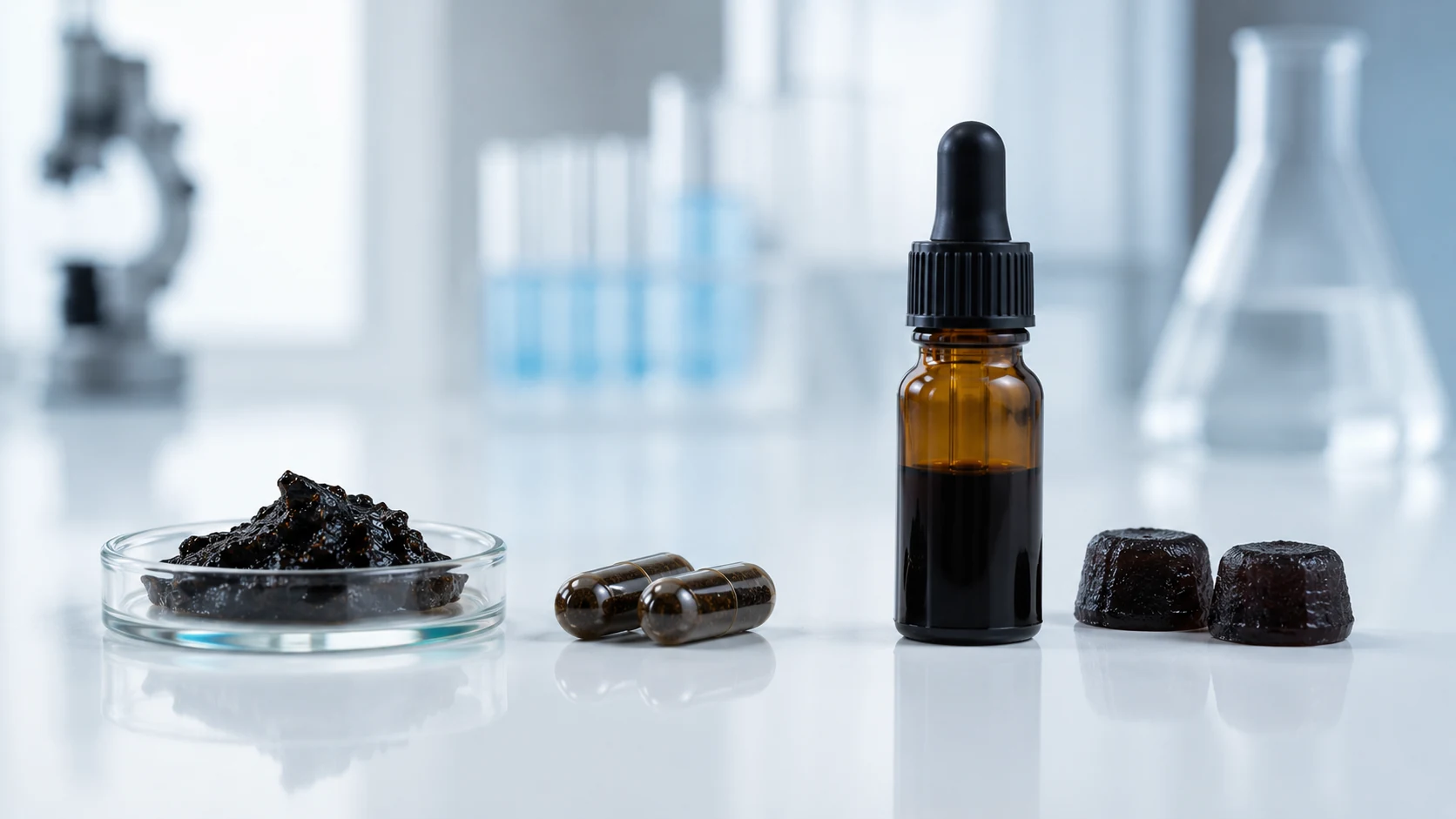
The best Shilajit form is the one that clearly identifies what it contains, how much it delivers and how the batch was tested. Resin is not automatically more authentic. Capsules are not automatically less effective. Gummies are not automatically useless. The formulation changes dose accuracy, convenience, ingredient transparency and how closely the product resembles the preparation used in research.
Resin
Resin is visually associated with traditional Shilajit.
Its texture can change with temperature and water content. It may soften when warm and become firmer when cold.
The main practical weakness is dosing. Terms such as pea-sized or rice-grain-sized are imprecise. A measured milligram serving is more reliable.
Colour, stretch, taste and solubility do not prove safety or authenticity.
Capsules
Capsules can provide a consistent measured amount.
Check whether the ingredient is purified Shilajit, a standardised extract, dried resin powder or a proprietary blend.
A 500 mg capsule is meaningful only when the 500 mg refers to Shilajit rather than the full blend or capsule fill.
Capsules may be easier for people who dislike the taste or texture of resin.
Gummies
Gummies offer convenience and may improve adherence.
They can also contain sweeteners, flavours, acids and several active ingredients.
Check the amount of Shilajit per serving. Do not assume that a prominent front-label claim reflects an amount comparable to human research.
Review the full ingredient list and serving size.
Powder
Powder may be a dried resin, extract, raw material or blend.
The label should state the form and processing. Powder is easy to weigh and mix, but the name alone does not show concentration or purity.
Moisture exposure and blending can affect handling and transparency.
Liquid
Liquid products should state concentration per millilitre or measured dropper.
A recommendation based only on a number of drops is not precise because drop size varies.
Confirm whether the liquid contains dissolved Shilajit, a standardised extract or a diluted multi-ingredient formula.
Multi-Ingredient Products
A positive result from a blend cannot be assigned to Shilajit alone.
The reverse is also true. Shilajit research does not validate every blend containing Shilajit.
Review each ingredient, its dose and its safety considerations.
Which Forms Were Studied?
Human studies used specific purified, processed or standardised preparations.
A 2026 open-label pilot studied a specific resin product. That pilot does not prove that every resin performs the same way.
The evidence does not identify one universally superior form. It shows that preparation identity matters.
Dose Clarity
Capsules and powders can make measured dosing easier.
Resin can also be dosed accurately when weighed. Gummies and liquids require careful label reading because the amount per serving may be less obvious.
Avoid products that provide only vague serving descriptions.
Quality Verification
Every form should have:
A premium package does not replace this evidence.
- Batch number.
- Ingredient identity.
- Amount per serving.
- Current laboratory report.
- Heavy-metal results.
- Microbiological quality-control results.
- Manufacturer information.
Convenience Versus Comparability
The most convenient form is not always the closest to the product used in a study.
Choose based on your practical needs, but do not claim study equivalence without comparable formulation and dose information.
Practical Comparison
Choose resin when you value the format and can measure it accurately.
Choose capsules when you want consistent measured servings and transparent composition.
Choose gummies for convenience only when the amount and full ingredient list are acceptable.
Choose liquid when concentration is clearly stated.
Choose powder when the processing and concentration are clear.
Form is secondary to identity, dose and batch quality. The strongest product is not the one with the most traditional appearance. It is the one you can evaluate, measure and verify.
Frequently asked questions
Editorial disclosure: The platform has commercial relationships with companies involved in Shilajit products. Affiliated and unaffiliated products are evaluated using the same published evidence and quality criteria. This article does not independently verify every product or batch.
Related articles
 Supplements
How Much Shilajit Should You Take? Study Doses, Product Labels and Practical Limits
There is no single evidence-based Shilajit dose for everyone. Human studies most often used 200 mg to 500 mg daily, while one collagen-biomarker trial tested 500 mg and 1,000 mg daily. These doses came from specific purified, processed or standardised preparations. They should not be copied blindly to every resin, capsule, gummy, powder or liquid. A practical dose decision starts with the exact formulation, measured serving, batch quality, study goal and personal health context.
 Supplements
Who Should Not Take Shilajit? Safety Questions That Matter Before You Start
Pregnant or breastfeeding people, children, people taking prescription medicines, those with diagnosed medical conditions, anyone planning surgery, and people with fertility, hormonal, bone-health or persistent-fatigue concerns should not start Shilajit without professional advice. Safety findings from small studies apply only to the tested preparations, doses and durations. Product identity, processing and batch-specific testing also matter.
 Supplements
What Makes Shilajit Safe to Use? A Practical Guide to Batch Testing and COAs
A useful Shilajit quality file links a real batch to a named laboratory, test date, methods, units and measured results. A generic certificate, old report or marketing badge does not verify the jar in your hand. Heavy metals, microbiology, formulation identity and claimed composition should be interpreted together. One result applies only to the tested sample or batch.