Does Shilajit Raise Testosterone? What One Human Trial Can, and Cannot, Tell Us
One randomized, double-blind, placebo-controlled trial reported increases in total testosterone, free testosterone and DHEA-S in healthy men aged 45 to 55 who took 250 mg of a specific purified Shilajit preparation twice daily for 90 days. This is meaningful but limited evidence. It does not establish treatment of low testosterone, improved symptoms, fertility, muscle gain or a universal effect across products and populations.
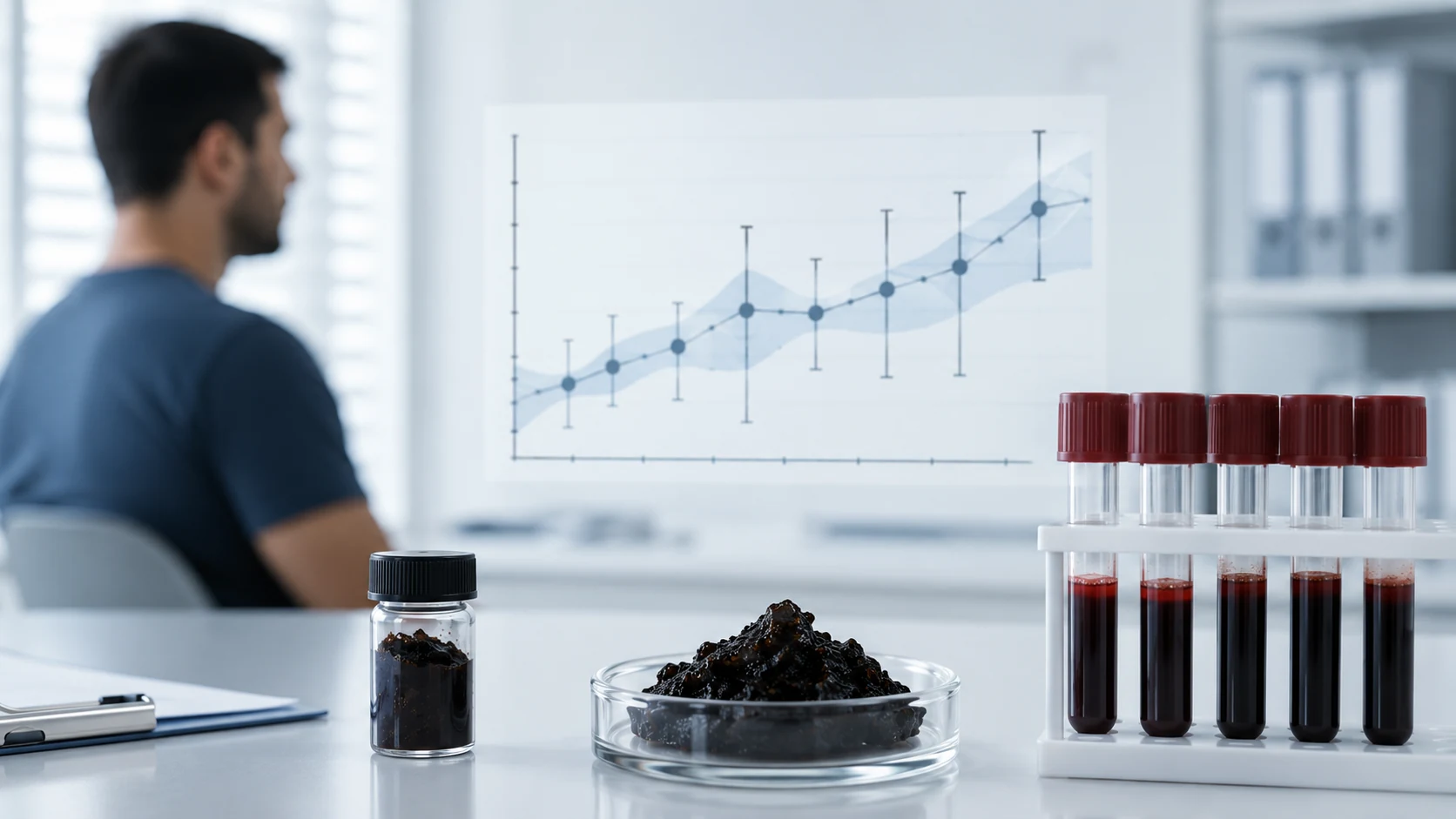
Shilajit has one controlled human trial directly focused on testosterone markers. Healthy men aged 45 to 55 took 250 mg of a specific purified Shilajit preparation twice daily, for a total of 500 mg daily, for 90 days. Total testosterone, free testosterone and DHEA-S increased compared with placebo. This supports a possible androgen-marker effect for that preparation in that population. It does not prove that Shilajit treats low testosterone or improves symptoms.
What the Trial Tested
The study was randomized, double-blind and placebo-controlled.
Participants were healthy middle-aged men. They were not selected because they had diagnosed hypogonadism.
The preparation was purified and standardised. The result should not be transferred automatically to every resin, gummy, liquid or untested product.
What Changed
The study reported statistically significant increases in total testosterone, free testosterone and DHEA-S after 90 days.
A laboratory change can be relevant. It does not automatically mean a person will notice improved energy, libido, mood, fertility or muscle growth.
The study should be interpreted according to the outcomes it actually measured.
What the Study Did Not Prove
It did not establish treatment of testosterone deficiency.
It did not prove improved sexual function, body composition, strength, fertility, quality of life or clinical symptoms.
It did not test women, younger men, older men outside the study range or people with diagnosed endocrine disorders.
Does the Percentage Increase Matter?
A percentage change can sound impressive without context.
Clinical meaning depends on the starting value, final value, symptoms, normal laboratory range and whether the change improves a meaningful health outcome.
The trial supports a biological effect on measured markers. It does not show that every participant experienced a noticeable benefit.
Product Applicability
The result applies to the specific purified preparation and dose used.
A seller cannot reasonably claim the same effect merely because a product contains Shilajit.
A resin may differ in moisture and composition. A gummy may contain a lower amount or a blend. A liquid may not state concentration clearly.
Comparable formulation, dose and batch quality matter.
The Fertility Question
A separate open-label study in men with oligospermia reported changes in semen parameters and testosterone.
It had no placebo group and did not measure pregnancy or live-birth outcomes.
This is preliminary evidence, not proof of infertility treatment.
Testosterone, Energy and Muscle
Testosterone marketing often connects one laboratory marker to energy, strength and muscle growth.
The testosterone trial did not establish these outcomes.
A separate muscular-fatigue study examined strength retention after an induced fatigue protocol. That result cannot be used to claim that testosterone caused the effect.
How Strong Is the Evidence?
The randomized, placebo-controlled design is stronger than an uncontrolled study.
The evidence base remains limited because the direct testosterone finding comes mainly from one trial using a specific proprietary preparation.
Independent replication in other populations and studies measuring symptoms would strengthen confidence.
Funding and Product-Specific Evidence
Research involving branded or proprietary ingredients is not automatically invalid.
It does increase the need for transparent funding, conflict disclosures, exact product identification and independent replication.
The correct wording is ingredient-specific, not category-wide.
Symptoms associated with low testosterone can have many causes. Anyone concerned about hormone levels should seek proper testing and clinical evaluation. Shilajit should not replace diagnosis, monitoring or established care.
- Treats low testosterone.
- Works for every man.
- Produces guaranteed muscle growth.
- Improves libido in all users.
- Replaces testosterone therapy.
- Treats infertility.
The correct answer is narrower than both marketing and dismissal. Shilajit may influence testosterone markers in healthy men aged 45 to 55 when used as a specific purified preparation at 500 mg daily for 90 days. Whether it improves symptoms, helps other populations or applies to ordinary commercial products remains unproven.
Frequently asked questions
Editorial disclosure: The platform has commercial relationships with companies involved in Shilajit products. Affiliated and unaffiliated products are evaluated using the same published evidence and quality criteria. This article does not independently verify every product or batch.
Related articles
 Supplements
How Much Shilajit Should You Take? Study Doses, Product Labels and Practical Limits
There is no single evidence-based Shilajit dose for everyone. Human studies most often used 200 mg to 500 mg daily, while one collagen-biomarker trial tested 500 mg and 1,000 mg daily. These doses came from specific purified, processed or standardised preparations. They should not be copied blindly to every resin, capsule, gummy, powder or liquid. A practical dose decision starts with the exact formulation, measured serving, batch quality, study goal and personal health context.
 Supplements
Who Should Not Take Shilajit? Safety Questions That Matter Before You Start
Pregnant or breastfeeding people, children, people taking prescription medicines, those with diagnosed medical conditions, anyone planning surgery, and people with fertility, hormonal, bone-health or persistent-fatigue concerns should not start Shilajit without professional advice. Safety findings from small studies apply only to the tested preparations, doses and durations. Product identity, processing and batch-specific testing also matter.
 Supplements
What Makes Shilajit Safe to Use? A Practical Guide to Batch Testing and COAs
A useful Shilajit quality file links a real batch to a named laboratory, test date, methods, units and measured results. A generic certificate, old report or marketing badge does not verify the jar in your hand. Heavy metals, microbiology, formulation identity and claimed composition should be interpreted together. One result applies only to the tested sample or batch.