Cystatin C Blood Test: When It Adds Useful Information Beyond Creatinine
Learn what cystatin C measures, why it's less affected by muscle mass than creatinine, and when guidelines recommend using it to confirm a borderline eGFR result.
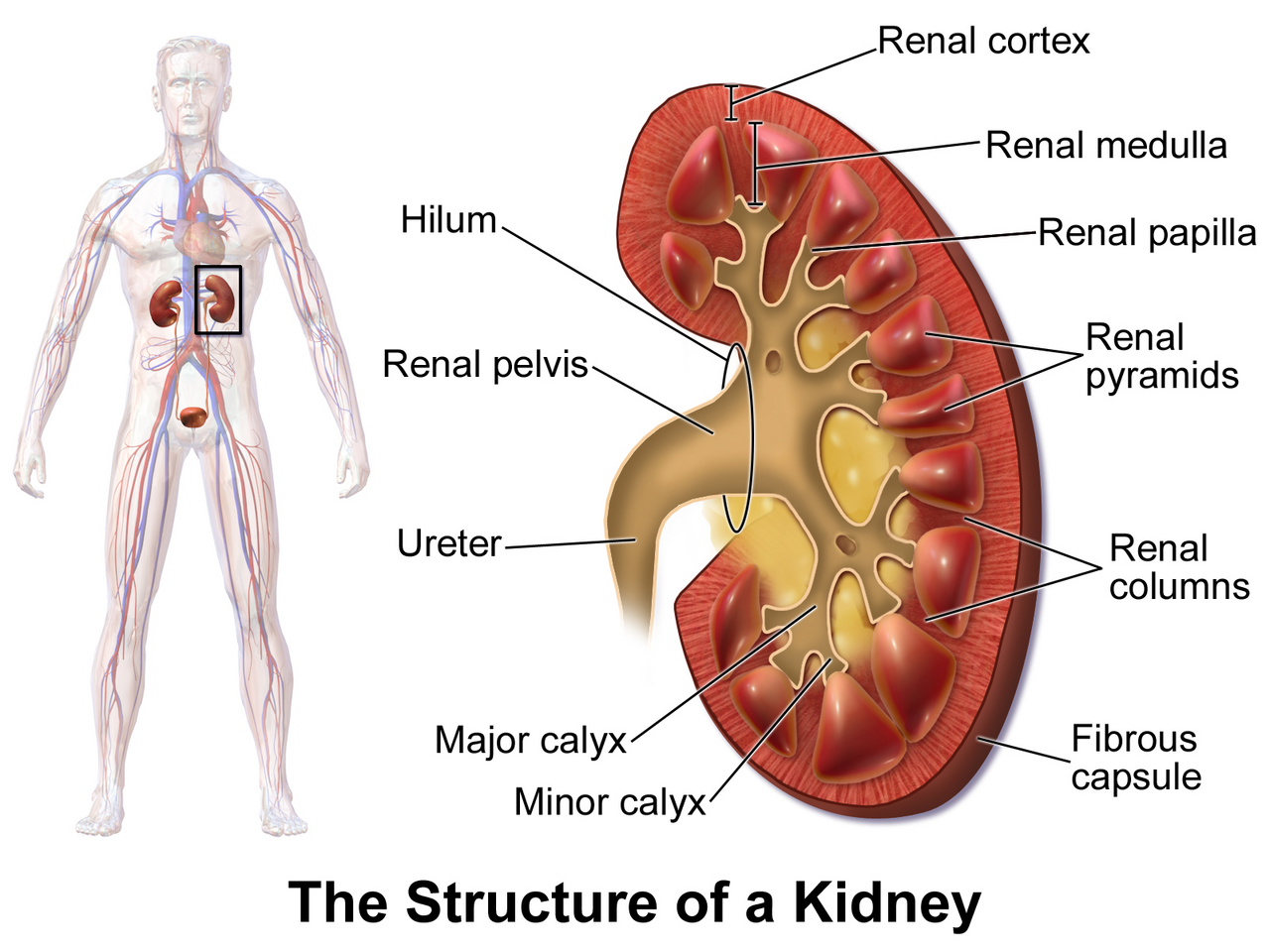
Image: BruceBlaus / Wikimedia Commons / CC BY 3.0
Cystatin C is a small protein produced by nearly every cell in the body at a fairly steady rate, and it's used to calculate an alternative estimate of kidney filtration (called eGFRcys) that's less influenced by muscle mass than the standard creatinine-based eGFR. Current guidelines recommend measuring cystatin C specifically to help confirm a chronic kidney disease diagnosis in adults whose creatinine-based eGFR falls in an intermediate, ambiguous range without other clear signs of kidney damage — precisely the situation where muscle-mass-related inaccuracy in creatinine-based eGFR is most likely to mislead. It is not intended as a routine, universal substitute for creatinine in every person getting a kidney function test.
Creatinine's biggest limitation is that it's a byproduct of muscle, so it doesn't mean quite the same thing in a bodybuilder as it does in someone who's lost significant muscle mass through illness or age. Cystatin C sidesteps this specific problem, since production isn't tied to muscle in the same way — but it brings its own smaller set of confounders, including inflammation and thyroid status.
- Cystatin C is produced by nearly all cells and is less dependent on muscle mass than creatinine.
- Current guidelines recommend it mainly to confirm CKD in adults with a creatinine-based eGFR in an ambiguous intermediate range (roughly 45–59 mL/min/1.73m²) and no other clear kidney-damage marker.
- It is not a routine, universal replacement for creatinine-based testing.
- Like creatinine-based eGFR, a single cystatin C-based result cannot establish chronicity on its own.
What the test measures
Cystatin C is a protein produced continuously by virtually all nucleated cells in the body, and it's freely filtered by the kidneys without being significantly reabsorbed or secreted by the kidney tubules, similar in principle to creatinine. Because its production doesn't depend heavily on muscle mass the way creatinine's does, cystatin C blood levels are thought to more consistently reflect true filtration rate across people with different body compositions.
How the main pattern is interpreted
eGFR can be calculated using cystatin C alone (eGFRcys) or combined with creatinine (eGFRcr-cys), and current guidance specifically recommends the combined equation in situations where confirmation of a creatinine-based result is needed. If a creatinine-based eGFR and a cystatin C-based eGFR are broadly consistent with each other, this increases confidence in the result. If they disagree meaningfully, this discordance itself is informative and often prompts a closer look at factors like muscle mass, inflammation, or thyroid function that could be affecting one measure more than the other.
Reference ranges versus diagnostic thresholds
Cystatin C-based eGFR uses the same category framework as creatinine-based eGFR (G1 through G5), since both are attempting to estimate the same underlying physiological quantity — filtration rate. The specific clinical scenario where guidelines most clearly recommend cystatin C is confirmatory testing in adults with a creatinine-based eGFR of roughly 45 to 59 mL/min/1.73m² and no other marker of kidney damage (such as elevated uACR), since this intermediate range is exactly where reclassification based on a more muscle-mass-independent measure is most likely to change the overall risk picture.
What can distort the result
While cystatin C is less affected by muscle mass than creatinine, it isn't immune to other confounders. Significant systemic inflammation, uncontrolled thyroid disease (both hyper- and hypothyroidism), and, to a lesser extent than with creatinine, body composition and smoking status have all been associated with changes in cystatin C independent of true kidney filtration.
What the result does not prove
A single cystatin C-based eGFR does not, by itself, establish chronic kidney disease — like creatinine-based eGFR, it requires persistence over time (generally three months or more) and, ideally, corroboration with albuminuria status before a diagnosis is made.
Common misunderstandings
A common misunderstanding is assuming cystatin C is simply a 'better' test that should replace creatinine for everyone. Its main advantage is specific to situations where muscle mass is atypical or where a creatinine-based result is ambiguous; for most people with typical muscle mass and a clearly normal or clearly abnormal creatinine-based eGFR, cystatin C adds little additional information.
Practical next-step guidance
If your creatinine-based eGFR falls in the intermediate 45–59 mL/min/1.73m² range without other clear signs of kidney damage, asking whether cystatin C-based confirmatory testing is appropriate is a reasonable question for a clinician. If you have unusually high or low muscle mass — from bodybuilding, long-term illness, or limb loss — mentioning this is useful context when your eGFR result is being interpreted.
- A significant discordance between creatinine-based and cystatin C-based eGFR results is best clarified through clinical evaluation rather than self-interpretation, since several distinct underlying explanations are possible.
Limitations and uncertainty
Cystatin C is not universally available and is not intended as first-line, routine testing for everyone; its value is concentrated in specific diagnostic-uncertainty situations rather than across the general population.
Frequently asked questions
Related articles
 Kidney Function & Electrolytes
Creatinine and eGFR: What These Kidney Function Results Mean Together
Understand what creatinine and estimated GFR (eGFR) measure, why eGFR is a calculated estimate rather than a direct measurement, and why one result cannot diagnose chronic kidney disease on its own.
 Kidney Function & Electrolytes
BUN Blood Test Explained: What High and Low Results Can Mean
Learn what blood urea nitrogen (BUN) measures, why it can rise for reasons unrelated to kidney filtration, and why the BUN-to-creatinine ratio adds context a single BUN value can't.
 Kidney Function & Electrolytes
Urine Albumin-to-Creatinine Ratio: An Early Kidney-Damage Test Explained
Learn why urine albumin-to-creatinine ratio (uACR) can detect kidney damage before eGFR falls, how the A1/A2/A3 categories work, and what can cause a falsely elevated result.