Bilirubin Explained: Direct, Indirect, Total and What Jaundice Means
Bilirubin above 2 mg/dL usually shows as visible jaundice. Whether the direct or indirect fraction dominates points to a completely different diagnosis.
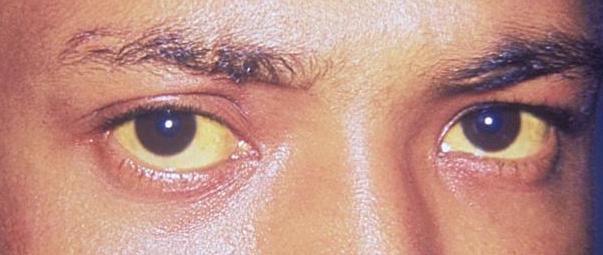
Normal total bilirubin is below 1.2 mg/dL (20 µmol/L). Bilirubin above ~2 mg/dL becomes visible as jaundice. Predominantly INDIRECT (unconjugated) hyperbilirubinaemia points at haemolysis or Gilbert's syndrome. Predominantly DIRECT (conjugated) hyperbilirubinaemia points at liver disease or biliary obstruction.
Bilirubin is the breakdown product of haem. Unconjugated (indirect) bilirubin travels bound to albumin; the liver conjugates it into water-soluble direct bilirubin, which is excreted in bile. Two mechanistic patterns emerge. Predominantly indirect (unconjugated) hyperbilirubinaemia: haemolysis (raised LDH, low haptoglobin, high reticulocytes), Gilbert's syndrome (~7% of population, benign, worse with fasting/stress), neonatal jaundice, ineffective erythropoiesis. Predominantly direct (conjugated) hyperbilirubinaemia: hepatocellular injury (viral hepatitis, drug injury, alcoholic hepatitis) with raised transaminases, cholestasis (raised ALP, GGT) — from gallstones, PSC, PBC, drug-induced cholestasis, or malignancy. Total bilirubin > 3 mg/dL almost always requires investigation.
- Normal total bilirubin
- < 1.2 mg/dL (< 20 µmol/L)
- Visible jaundice starts at
- ~2 mg/dL
- Direct fraction elevated
- Liver or biliary disease
- Indirect fraction elevated
- Haemolysis or Gilbert's
- Gilbert's syndrome prevalence
- ~7%
Direct vs indirect — the fork in the diagnosis
Predominantly INDIRECT (unconjugated): the liver conjugation step is intact but overwhelmed (haemolysis) or genetically slower (Gilbert's, Crigler-Najjar). Rule of thumb: bilirubin up but transaminases and ALP normal, with rising retic count and haptoglobin dropping → haemolysis. Mildly raised bilirubin with everything else normal, worse with fasting or illness → Gilbert's.
Predominantly DIRECT (conjugated): the liver cannot excrete conjugated bilirubin. Two subtypes matter — hepatocellular (transaminases elevated) and cholestatic (ALP and GGT elevated). Cholestasis triggers imaging for ductal obstruction (gallstones, malignancy).
Bilirubin pattern matrix
| Pattern | Diagnosis to consider | Next test |
|---|---|---|
| ↑ Indirect, normal LFTs | Gilbert's syndrome, haemolysis | Reticulocytes, haptoglobin, LDH |
| ↑ Direct, high ALT/AST | Hepatocellular injury | Hepatitis serology, drug review |
| ↑ Direct, high ALP/GGT | Cholestasis | Ultrasound abdomen |
| ↑ Both, mixed | Advanced liver disease, obstruction | Full workup |
- Jaundice + fever + right upper quadrant pain — cholangitis.
- Jaundice + rapid weight loss + painless jaundice — pancreatic or biliary malignancy.
- Jaundice + confusion or bleeding — acute liver failure.
- Jaundice + splenomegaly + anaemia — severe haemolysis.
Bilirubin walk-through
- 1Indirect dominant, normal LFTs, mild elevation, worse with fasting?Gilbert's syndrome — benign, no further workup.
- 2Indirect dominant + anaemia + high LDH + low haptoglobin?Haemolysis — investigate cause.
- 3Direct dominant + high ALT/AST?Hepatocellular injury — hepatitis screen, drug review, alcohol history.
- 4Direct dominant + high ALP/GGT?Cholestasis — abdominal ultrasound to exclude ductal obstruction.
Related questions people ask
- What is Gilbert's syndrome?
- Does haemolysis raise bilirubin?
- What causes cholestatic jaundice?
- How does bilirubin fit into liver enzymes?
- Is bilirubin part of a CMP?
- How does hepatitis B affect bilirubin?
- What is neonatal jaundice?
Frequently asked questions
- Total bilirubin < 1.2 mg/dL is normal.
- Direct vs indirect dominance is the diagnostic fork.
- Indirect only: Gilbert's or haemolysis.
- Direct with ALT: hepatocellular.
- Direct with ALP/GGT: cholestasis.
- Painless jaundice + weight loss = red flag for pancreatic malignancy.
References
3 sources- AASLDApproach to the Patient with Abnormal Liver Tests
US hepatology framework.
aasld.org
- BSGGuidelines on Abnormal Liver Blood Tests
UK gastroenterology society.
bsg.org.uk
- NICE CKSJaundice in adults
UK NICE guidance.
cks.nice.org.uk
Evidence Snapshot
This snapshot shows verified evidence records matched to this article. It is not a diagnosis or personal medical advice.
Alkaline phosphatase (ALP) is a group of enzymes produced by several tissues, most notably liver, bone, intestine and placenta, and total serum ALP reflects contributions from all of these sources.
Limitation. Total serum ALP does not indicate which tissue an elevation comes from without additional testing.
Indirect bilirubin, also called unconjugated bilirubin, is the fraction of bilirubin that has not yet been processed by the liver and is typically reported as total bilirubin minus direct bilirubin.
Limitation. A calculated indirect bilirubin depends on the accuracy of both total and direct bilirubin measurements.
In intravascular haemolysis, serum LDH commonly rises because LDH is released from lysed red blood cells; it is typically interpreted alongside haptoglobin, bilirubin and a peripheral blood smear.
Limitation. LDH can also be raised by many non-haemolytic causes, so haemolysis interpretation relies on a set of tests.
Related articles
 Laboratory Tests
TSH Test: Normal Range, High, Low & What Your Result Actually Means
TSH is the single most important thyroid number. Understand normal ranges by age and pregnancy, what a high or low value really tells you, and the two follow-up tests that clinch the diagnosis.
 Laboratory Tests
HbA1c Test: Normal Range, Prediabetic, Diabetic Cut-offs & How to Lower It
HbA1c reflects your average blood sugar over ~3 months. Understand every threshold — normal, prediabetes, diabetes — and the realistic actions that move the number.
 Laboratory Tests
LDL Cholesterol: Optimal Numbers, High Numbers, and How to Read Yours
LDL is the "bad" cholesterol only if you leave the story there. Understand optimal targets by risk group, the ApoB perspective, and the interventions that actually shift the number.