FSH and LH Blood Test: Menopause Diagnosis and Fertility Explained
FSH is not needed to diagnose menopause in women over 45. Learn when to test, cycle-day timing, and what LH:FSH ratios mean.
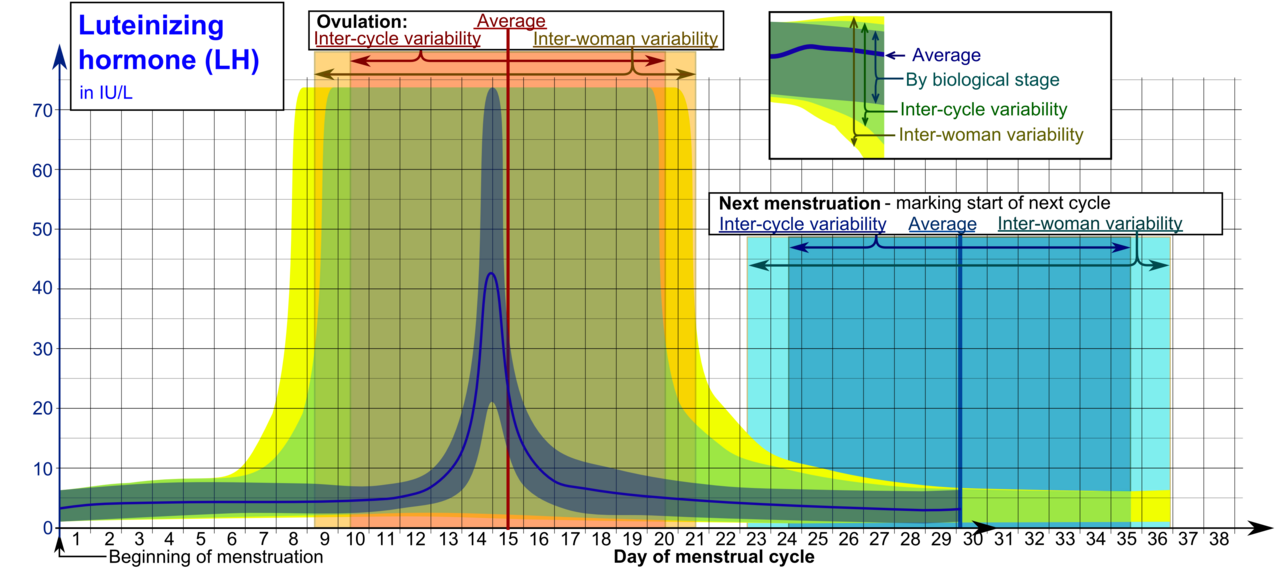
NICE explicitly recommends NOT testing FSH to diagnose menopause in women over 45 — the diagnosis is clinical (12 months of amenorrhoea with typical symptoms). Test only in women 40–45 with menopausal symptoms, women under 40 with amenorrhoea (premature ovarian insufficiency), and in fertility workups. LH > 25 on day 2–5 or LH:FSH ratio > 2 with hyperandrogenism supports PCOS.
FSH and LH are anterior pituitary gonadotrophins under GnRH control from the hypothalamus. Their levels vary hugely across the menstrual cycle, so day-of-cycle timing is critical for interpretation. NICE NG23 (2015, reaffirmed 2019) is clear: menopause is a clinical diagnosis in women > 45 — FSH testing is not indicated. Testing IS indicated for: women 40–45 with vasomotor symptoms and cycle changes; women < 40 with 4+ months amenorrhoea (premature ovarian insufficiency needs FSH > 25 IU/L on two samples 4+ weeks apart); differential diagnosis of hypogonadism (low FSH/LH + low sex hormones = hypogonadotrophic; high FSH/LH + low sex hormones = hypergonadotrophic/primary ovarian failure); PCOS support (LH:FSH ratio > 2 has poor sensitivity but supports diagnosis when combined with hyperandrogenism and ovulatory dysfunction). In fertility workup, cycle day 2–5 FSH > 10 IU/L suggests diminished ovarian reserve — but AMH is now preferred.
- Menopause range FSH
- > 30 IU/L on two samples
- Post-menopausal LH
- 15 – 60 IU/L
- Not indicated
- Women > 45 with typical menopause
- POI criteria
- FSH > 25, twice, > 4 wk apart, < 40 y
- PCOS ratio
- LH:FSH > 2 (weak criterion)
FSH/LH patterns
| Pattern | Interpretation |
|---|---|
| High FSH + high LH + low oestradiol | Primary ovarian failure / menopause / POI |
| Low FSH + low LH + low oestradiol | Hypogonadotrophic hypogonadism (pituitary/hypothalamic) |
| LH:FSH > 2 + hyperandrogenism + oligo-amenorrhoea | PCOS support |
| Normal FSH/LH + secondary amenorrhoea | Consider prolactin, TSH, pregnancy |
When NICE recommends testing
Women 40–45 with menopausal symptoms and change in menstrual cycle.
Women under 40 with menopausal symptoms — premature ovarian insufficiency workup.
Women on hormonal contraception where symptom-based diagnosis is uncertain (limited reliability).
- Menopausal symptoms + FSH > 25 in a woman under 40 — POI diagnosis and bone density.
- Amenorrhoea + galactorrhoea — check prolactin.
- Low FSH/LH + visual symptoms — pituitary MRI.
FSH/LH workup
- 1Woman > 45 with menopausal symptoms?No test needed — clinical diagnosis.
- 2Woman < 40 with amenorrhoea?FSH ×2, LH, oestradiol, prolactin, TSH, hCG. POI if FSH > 25 twice.
- 3Suspected PCOS?LH:FSH ratio has weak specificity. Prefer androgens + AMH + ultrasound.
- 4Low FSH/LH?Pituitary workup (prolactin, TFT, cortisol, IGF-1, MRI).
Related questions people ask
Frequently asked questions
- Do not test FSH to diagnose menopause in women > 45.
- POI requires FSH > 25 on two samples 4+ weeks apart.
- LH:FSH ratio has weak specificity for PCOS.
- Cycle day 2–5 is standard baseline timing.
- Hormonal contraception invalidates results.
References
2 sources- NICE NG23Menopause: diagnosis and management
UK national guideline.
nice.org.uk
- ESHREPremature Ovarian Insufficiency Guideline (2024)
European fertility society.
eshre.eu
Evidence Snapshot
This snapshot shows verified evidence records matched to this article. It is not a diagnosis or personal medical advice.
After menopause, LH and FSH values are typically elevated because ovarian oestrogen production has declined and negative feedback on the pituitary is reduced.
Limitation. LH and FSH alone do not date the onset of menopause and are not required for a clinical menopause diagnosis in individuals with typical symptoms and age.
For evaluation of suspected male hypogonadism, guidelines recommend measuring total testosterone on a morning fasting sample because testosterone shows a diurnal pattern with higher morning values and can be lowered by recent food intake.
Limitation. The diurnal pattern is less pronounced in older men, and reference ranges vary between assay platforms.
Related articles
 Laboratory Tests
TSH Test: Normal Range, High, Low & What Your Result Actually Means
TSH is the single most important thyroid number. Understand normal ranges by age and pregnancy, what a high or low value really tells you, and the two follow-up tests that clinch the diagnosis.
 Laboratory Tests
HbA1c Test: Normal Range, Prediabetic, Diabetic Cut-offs & How to Lower It
HbA1c reflects your average blood sugar over ~3 months. Understand every threshold — normal, prediabetes, diabetes — and the realistic actions that move the number.
 Laboratory Tests
LDL Cholesterol: Optimal Numbers, High Numbers, and How to Read Yours
LDL is the "bad" cholesterol only if you leave the story there. Understand optimal targets by risk group, the ApoB perspective, and the interventions that actually shift the number.